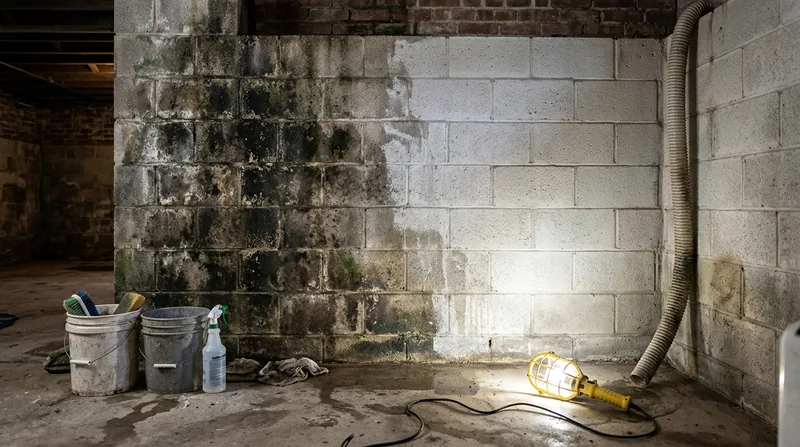




Mold in a Suffolk basement is almost never a mold problem first. It is a water problem that has been running quietly for months. Our Basement Mold Remediation in Suffolk service pairs containment and treatment of the affected surfaces with the moisture fix that keeps growth from returning: drainage correction, sump work, wall sealing, or dehumidification sized to the space. Suffolk sits on flat coastal plain, sandy loam over clay, with the water table only a few feet down and slow drainage toward the Nansemond, Elizabeth and Blackwater rivers. Full basements are rare here, so most of what we treat is in the older brick and block cellars and partial basements downtown and along the old rail corridor, plus finished lower levels in Harbour View and on the walkout lots near the Nansemond. If you smell that musty odor after a summer thunderstorm, start with a free basement inspection before anyone quotes you a treatment number.
Why Basement Mold Remediation Matters in Suffolk's Older Cellars and Waterfront Lower Levels
Suffolk summers are hot and humid with heavy thunderstorms, and the ground here does not drain fast. Sandy loam sits over clay, so water perches, pushes against the foundation, and finds the path of least resistance through block joints, tie holes, and old brick mortar. Add tidal backwater that rises into low streets during nor'easters and hurricanes, and a wet basement becomes a recurring event rather than a one-time accident. Mold needs moisture and a food source, and paper-faced drywall, wood framing, and stored cardboard in a damp cellar supply both. The failure mode that dominates here is hydrostatic pressure after prolonged rain, not a single burst pipe.
- Efflorescence on the block tells you water is moving through the wall, not just condensing on it.
- A musty basement smell that gets stronger after storms points to recurring seepage at the cove joint or floor crack.
- Peeling paint and soft drywall at the bottom two feet of a finished wall usually means water is wicking up from the slab.
- Rust on a sump pump float or a pump that runs long after rain stops signals a check valve or discharge line problem.
Treat the mold without fixing the moisture and it comes back with the next nor'easter, which is why we diagnose first and treat second.
Key info: In a 1920s brick cellar off East Washington Street in downtown Suffolk, we found mold on the joist ends and a white efflorescence bloom on the wall. The source was a failed footing drain and a downspout dumping at the corner. Treating the wood without correcting that grading would have wasted the homeowner's money.
For the official word on what work requires a permit in the City of Suffolk, check the City of Suffolk building department before you schedule anything structural or any change to drainage.
How We Run Basement Mold Remediation in Suffolk: Diagnose the Moisture, Then Remove the Growth
We start with the musty smell diagnostics and a moisture map of the space. That means a pin-type meter on framing and drywall, a hygrometer reading for relative humidity, and a visual check of the wall base, cove joint, window wells, and sump basin. From there we build a containment, remove or treat affected materials, and correct the water path. The order matters: remediation without drainage correction is a callback waiting to happen. If the wall is actively weeping, we look at basement wall sealing or an interior perimeter drain before we close anything up.
- We inspect and document the moisture source, including grading, downspout discharge, window wells, and the sump pit.
- We set up containment with poly sheeting and negative air pressure so spores do not spread to the rest of the house.
- We remove porous materials that cannot be cleaned (wet drywall, saturated insulation, ruined cardboard) and bag them on site.
- We treat structural surfaces with an antimicrobial agent and HEPA-vacuum the framing and floor.
- We correct the moisture path: extend downspouts, regrade the soil, repair the sump pump or check valve, or install drainage.
- We verify with a moisture meter and set up dehumidification sized to the cubic footage of the basement.
We do not sign off until the meter reads dry and the musty smell is gone, not masked.
Key info: A walkout lower level near the Nansemond River in Harbour View had mold on the baseboard and a damp carpet pad after a September storm. The sump pump had failed and the discharge line was buried in the yard with no freeze protection. We replaced the pump, added a battery backup sump pump, and rerouted the discharge before treating the wall.
Remediation Approaches We Use in Suffolk Basements
Not every mold job is the same scope. A small patch on a block wall in a Driver ranch with a partial basement is a different job from a finished lower level with saturated drywall. The table below shows how we match the approach to the condition we find.
| Approach | Description | Best for |
|---|---|---|
| Surface treatment and HEPA cleaning | Antimicrobial application on block or concrete, HEPA vacuum of framing and floor, no material removal. | Light surface growth on masonry with a known, correctable moisture source. |
| Containment and selective demolition | Poly containment with negative air, removal of wet drywall and insulation, bagging and disposal. | Finished basement walls with mold behind the drywall after a sump failure or wall seepage. |
| Remediation plus drainage correction | Treatment combined with interior drain tile, sump replacement, or grading and downspout work. | Recurring mold after every heavy rain, especially in low blocks near tidal backwater. |
| Remediation plus vapor control | Treatment followed by a vapor barrier and dehumidification sized to the space. | Damp cellars with high humidity and condensation but no active wall seepage. |
| Full scope with moisture verification | All of the above plus meter readings and a written moisture record at closeout. | Large finished lower levels and any job where the source was not obvious. |
Basement Mold Remediation Cost in Suffolk: What to Expect
Most basement mold remediation jobs in Suffolk start around $1,500, and that figure covers a defined scope: containment, treatment of the affected surfaces, HEPA cleaning, and a moisture check at closeout. What moves the number up is the size of the affected area, whether finished materials have to come out, and whether the moisture fix is included. A small patch on an unfinished block wall in Chuckatuck is at the low end. A finished lower level in Harbour View with mold behind the drywall and a failed sump pump runs higher because demolition, disposal, and drainage work are part of the job. Access matters too: a narrow cellar stair and a low clearance slow the work. Getting two or three estimates is smart, but make sure each one includes the moisture correction, not just the treatment. A cheap treatment quote that ignores the water source is the most expensive option in the long run. Our full pricing overview breaks down the line items so you can compare quotes apples to apples.
What to Look For When Hiring a Basement Mold Remediation Contractor Near Suffolk
Mold work is unregulated in Virginia compared to some states, so the contractor's own standards are what protect you. Ask for the license and insurance certificate before work starts, and confirm the policy covers mold remediation, not just general construction. Get at least two or three written estimates with the scope spelled out, and ask each contractor how they will correct the moisture source, not just kill what is visible. Check references from jobs in Suffolk or the surrounding counties, ideally ones with the same building type as yours. If structural repair, egress window cutting, or a change to the sump discharge connection is part of the scope, ask who pulls the permit and confirm the threshold with the local building department, because rules vary by jurisdiction. Finally, read the warranty terms: we offer a transferable warranty, and you should know exactly what it covers. To schedule an inspection, use our contact page or call (757) 538-6013.
Basement Mold Remediation in Suffolk: Pricing Guide
| Service | Price | Details |
|---|---|---|
| Surface treatment and HEPA cleaning | Starting at $1,500 | Containment, antimicrobial treatment on masonry, HEPA vacuum, moisture check at closeout. |
| Containment and selective demolition | Starting at $2,400 | Negative air containment, removal of wet drywall and insulation, bagging and disposal included. |
| Remediation plus drainage correction | Starting at $3,200 | Treatment combined with sump repair, interior drain tile, or grading and downspout correction. |
| Complex or large-scale job | On estimate | Finished lower levels and jobs with an unclear moisture source need an on-site look first. |
| Travel | Included | In Suffolk and surrounding areas, no separate call-out or mileage fee. |
| Estimate | Free | Response within 24h at (757) 538-6013, no obligation to book. |
Indicative pricing, the exact cost depends on square footage, finish, and site access. Free personalized estimate within 24h at (757) 538-6013.


