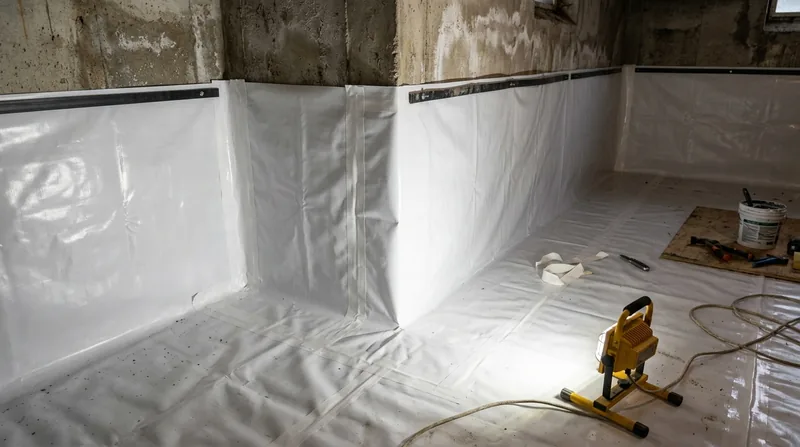




Suffolk sits on flat coastal plain ground, sandy loam over clay, with the water table only a few feet down and slow drainage toward the Nansemond, Elizabeth and Blackwater rivers. Full basements are rare here, so the below-grade spaces we see are mostly old brick and block cellars downtown and partial basements along the old rail corridor. When ground moisture wicks through those walls and slabs, Vapor Barrier Installation in Suffolk is the direct fix: heavy-duty sheets sealed across the walls and floor to block damp soil vapor from entering the lower level. We install the barrier with sealed seams, taped terminations and sump integration where the floor drains. If you are still diagnosing a wet basement, start with our basement waterproofing service and we will tell you plainly whether a barrier alone is enough.
Why Vapor Barrier Installation Matters in Suffolk's Damp, Low-Lying Ground
Most of Suffolk's housing stock was not built with a modern moisture barrier under the slab. The 1900s-1940s frame and brick houses near downtown often have brick cellars that pull ground moisture straight through the mortar. In the 1990s-2010s subdivisions around Harbour View and near the Nansemond River, slab-on-grade construction sits over soil that stays damp year round, and tidal backwater during nor'easters pushes the water table up into low streets. That moisture shows up as efflorescence, a musty basement smell and wall seepage after heavy summer thunderstorms, and it is the reason a sealed barrier matters more here than in drier inland markets.
- The barrier blocks soil vapor from moving through the slab and wall face into the basement air.
- Sealed seams and taped terminations keep moisture from bypassing the sheet at laps and penetrations.
- Sump integration ties the barrier into the drainage system so water collected below the slab has a path out.
- The work supports moisture control and prevention of mold growth on damp framing and stored materials.
A properly installed barrier is a moisture-control layer, not a cosmetic liner, and it belongs in the same conversation as your drainage and crack repair plan.
Key info: In a 1920s brick cellar off the old rail corridor in downtown Suffolk, we commonly find white efflorescence on the lower block courses and a damp slab. That is ground vapor, not a plumbing leak, and a sealed vapor barrier addresses it directly.
For local code and permit questions on work that alters drainage or the sump discharge, verify requirements with the City of Suffolk building department before work begins, since rules vary by jurisdiction.
How We Install a Vapor Barrier in a Suffolk Basement
We start by finding where the moisture is actually coming from. In Suffolk's sandy loam over clay, hydrostatic pressure and a high water table drive most of the problem, so the barrier has to be part of a system, not a sheet stapled to a damp wall. We inspect the walls and slab, check for active seepage and confirm the sump and drain tile are working before we seal anything over them. If the floor needs drainage first, we coordinate with our interior drain tile system so the barrier and the drainage work together.
- We clear the basement, inspect the walls and slab, and map damp zones, cracks and penetrations.
- We correct active leaks first, using epoxy or polyurethane injection on foundation cracks where needed.
- We install heavy-duty vapor barrier sheets across the walls and floor, overlapping laps in the direction of drainage.
- We seal every seam with compatible tape and terminate the sheet at the perimeter and around pipes.
- We integrate the barrier with the sump basin and discharge line, and check the check valve.
- We walk the job with you and explain what to watch for after the next heavy rain.
The result is a continuous, sealed layer that keeps ground vapor out of the lower level instead of letting it pass through the slab.
Key info: On a walkout lot near the Nansemond River, the uphill wall stays wet long after rain because the water table sits high behind it. We seal the seams tight and tie the barrier to the sump so the collected moisture has somewhere to go.
Vapor Barrier Approaches We Use in Suffolk
Not every basement needs the same sheet or the same detail work. The right approach depends on whether the walls are brick, block or poured concrete, how much hydrostatic pressure the site carries, and whether a sump is already in place. Here is how we match the method to the building.
| Approach | Description | Best for |
|---|---|---|
| Wall and slab sheet barrier | Heavy-duty sheets run across walls and floor with sealed laps and taped terminations. | Damp brick and block cellars downtown and along the old rail corridor. |
| Dimple board drainage layer | Dimpled membrane holds the barrier off the wall and gives water a path down to the drain. | Walls with active seepage and hydrostatic pressure behind them. |
| Sump-integrated barrier | Barrier ties into the sump basin and discharge line with a sealed termination at the pit. | Partial basements where groundwater collects below the slab. |
| Sealed patch and repair | Targeted barrier repair at tears, pipes and terminations where the existing sheet has failed. | Older installations with lifting seams or open penetrations. |
We choose the method after an on-site look, because a sheet that is right for a dry slab is wrong for a wall under pressure.
Vapor Barrier Installation Cost in Suffolk: What to Expect
Vapor barrier work is priced by the square foot of wall and floor covered, and rates start from $3/sq ft. A small partial basement in Driver or Holy Neck lands near that starting figure, while a larger space with heavy hydrostatic pressure, cracked walls or a failing sump moves the number up. Access matters too: a finished lower level with framing and stored goods takes more prep than an empty cellar. We give you a written scope before any work starts.
- Square footage of wall and slab to be covered is the main driver of the price.
- Wall condition matters, since cracks, efflorescence and failing parging need repair before the sheet goes up.
- Sump integration and any drain tile work add scope to the job.
- Access and prep time in a finished or cluttered basement affect labor.
Getting two or three estimates is smart, and you should compare what each one includes, not just the bottom line. Our full pricing overview lays out how we build a quote.
Vapor Barrier Installation Near Me: How to Vet a Contractor Near Suffolk
When you search for vapor barrier installation near me, the results all look similar. The difference is in the paperwork and the references. Ask for proof of licensing and insurance, get the scope in writing, and call a couple of past customers in Suffolk or Chesapeake before you sign. Confirm who pulls any permit if the job alters drainage or the sump discharge, and check with your HOA if you live in one of the Harbour View subdivisions before work starts.
- Confirm the contractor is licensed and insured, and ask for a certificate of insurance.
- Get two or three written estimates with the same scope so the comparison is fair.
- Ask for references from jobs in Suffolk, Portsmouth or Smithfield and actually call them.
- Verify permit responsibility in writing with the City of Suffolk building department.
- Check HOA rules for access, parking and work hours before the crew arrives.
A contractor who answers these questions plainly is the one you want under your floor. Reach us through our contact page to set up a free basement inspection.
Vapor Barrier Installation in Suffolk: Pricing Guide
| Service | Price | Details |
|---|---|---|
| Wall and slab vapor barrier | Starting at $3/sq ft | Heavy-duty sheet across walls and floor with sealed laps and taped terminations included |
| Dimple board drainage layer | Starting at $4/sq ft | Dimpled membrane behind the barrier for walls under active hydrostatic pressure |
| Sump-integrated barrier | Starting at $4.50/sq ft | Barrier sealed into the sump basin and discharge line, priced by covered area |
| Complex or large-scale job | On estimate | Cracked walls, failing sump or finished space need an on-site look before pricing |
| Travel | Included | In Suffolk and surrounding areas, no separate call-out or mileage fee |
| Estimate | Free | Response within 24h at (757) 538-6013, no obligation to book |
Indicative pricing, the exact cost depends on square footage, finish, and site access. Free personalized estimate within 24h at (757) 538-6013.


