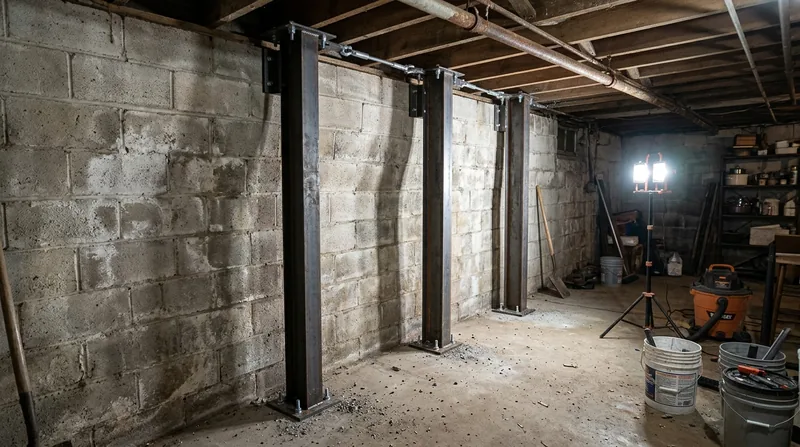




Most homes in Suffolk sit on flat coastal plain ground where the water table is only a few feet down, and that is exactly the condition that pushes a foundation wall inward over time. Sandy loam over clay drains slowly toward the Nansemond, Elizabeth and Blackwater rivers, and after a week of summer thunderstorms or a nor'easter pushing tidal backwater into low streets, saturated soil loads the wall from the outside. If you have a block or brick wall in an older downtown or rail-corridor house that has started to lean, Bowing Wall Repair in Suffolk is the work that stops the movement instead of hiding it. We look at the wall, the soil behind it and the drainage around the footing, then match the repair to how far the wall has actually moved. Full basements are rare in Hampton Roads, so the walls we stabilize are usually the older brick and block ones that have sat in wet ground for decades.
Why Bowing Walls Show Up in Suffolk's Older Building Stock
The housing here tells you where the problem lives. Downtown Suffolk and the old rail corridor have 1900s to 1940s frame and brick houses, a few with cellars or partial basements of brick and block, and those are the walls most exposed to decades of hydrostatic pressure. The 1950s to 1970s brick ranches in Driver, Holy Neck and Chuckatuck are mostly slab or raised pier, and the 1990s to 2010s subdivisions in Harbour View and along the Nansemond River are slab too, with a few walkout lots on the water. A bowing wall is a structural signal, not a cosmetic one, and it rarely gets better on its own.
- A horizontal crack in the middle third of a block wall usually points to soil pressure pushing inward.
- A wall that leans without a horizontal crack can still be moving at the top, and that needs a different anchor or strap layout.
- Efflorescence and white staining on the block tell you water has been moving through the wall for a long time.
- Doors and windows that suddenly stick on one side of the basement often follow the wall, not the frame.
Any one of these signs is worth a look before the next heavy rain season loads the soil again.
Key info: In a 1930s brick house off East Washington Street, a rear basement wall had walked inward about 1.5 inches over the years, with a horizontal crack at mid-height and heavy efflorescence. The soil behind it was saturated clay holding water against the wall after every storm. We stabilized the wall and corrected the drainage rather than repointing the crack and calling it done.
Structural foundation repair in Virginia is typically permitted work, and the rules vary by jurisdiction, so confirm the requirement with the City of Suffolk building department before work starts.
How We Diagnose and Stabilize a Bowing Wall in Suffolk
We start by measuring the movement, not guessing at it. A plumb line or laser against the wall face tells us how far the top has traveled, and a level check along the block courses tells us whether the wall is bowing in the middle or leaning as a unit. From there we look at what is pushing it: the soil, the water table, and whether the footing drain is still moving water away from the base. The repair follows the diagnosis, and the drainage correction usually runs alongside it so the wall is not fighting the same pressure again next season. If the wall has moved less than about an inch and the crack is tight, simple sealing may be all you need, and we will say so.
- We inspect the wall, the floor joint and the footing line, and we record the crack width and the amount of deflection.
- We check the grading and downspout discharge around the foundation, since roof water dumped at the wall is a common accelerant.
- We match the repair to the severity: carbon fiber straps for a wall that has bowed but not rotated, steel I-beams for a wall that needs a hard stop, wall anchors for a wall that has leaned at the top.
- We install the system, torque it to spec and photograph the wall before and after so the movement is documented.
- We correct the drainage and the discharge so the repaired wall is not reloaded by the same water.
The goal is a wall that holds its position, with a repair you can point to years later if you ever sell the house.
Key info: On a 1960s block wall in Chuckatuck, the wall had bowed about 2 inches at mid-height with no top rotation. Carbon fiber straps alone would have held the middle but not addressed the water, so we paired the straps with grading correction and a downspout extension that carried roof water past the footing. A foundation waterproofing review confirmed the footing drain was still open.
Repair Methods We Use and When Each One Fits
There is no single repair that fits every bowing wall, and the wrong method wastes money without stopping the movement. The table below shows how we match the system to the wall and the pressure behind it. We will tell you plainly when a crack is minor enough that sealing is enough and when the real driver is hydrostatic pressure that needs drainage work first.
| Approach | Description | Best for |
|---|---|---|
| Carbon fiber straps | Straps bonded to the wall face and anchored top and bottom to resist inward movement. | Block walls with a horizontal crack and moderate bowing, no top rotation. |
| Steel I-beams | Vertical steel members set against the wall and tied into the floor and joist system. | Walls that have moved significantly and need a hard structural stop. |
| Wall anchors | Earth anchors set outside the wall and connected through the wall to an interior plate. | Walls that have leaned or rotated at the top, where straps alone will not hold. |
| Drainage correction | Grading, downspout extensions and footing drain work to relieve soil pressure. | Any wall where saturated soil is the driving force, paired with the structural repair. |
Most jobs combine one structural method with drainage work, because a strap on a wet wall is only half a repair.
Bowing Wall Repair Cost in Suffolk: What to Expect
Pricing starts from $600 for the smallest scope, which is typically a limited crack or movement assessment with minor sealing, and climbs from there as the wall and the drainage work get more involved. The number depends on how far the wall has moved, how many straps or beams the wall needs, whether anchors are required, and how much drainage correction has to happen around the footing. Access matters too: a wall behind a finished basement or a tight window well takes longer than an open wall. Two or three estimates is the right move on a job this size, and any contractor who quotes a structural repair without measuring the deflection is guessing. You can see how the ranges break down on our pricing page.
What to Look For When Hiring a Bowing Wall Repair Contractor Near Suffolk
Ask for the license and insurance certificate before anyone touches the wall, and confirm the policy covers structural work, not just general handyman coverage. Ask how the contractor measures movement and whether you will get before-and-after documentation, because that record matters if the wall is ever inspected again. Ask about permits and who pulls them, since structural foundation repair commonly requires one and the rules vary by jurisdiction. Ask for references on comparable block or brick walls, not just waterproofing jobs. When you are ready to talk, reach us through the contact page.
Bowing Wall Repair Near Me: What Suffolk Homeowners Should Know
If you are searching for bowing wall repair near me and you live in Suffolk, Chesapeake, Portsmouth, Smithfield, Windsor or the surrounding towns, the first question is whether the wall is actually moving or just showing an old crack. A wall that has been stable for twenty years with a hairline crack is a different job from a wall that has moved an inch in the last two seasons. We check the wall, the soil and the drainage together, because a structural repair without drainage correction usually comes back. Call (757) 538-6013 and we will set up a free basement inspection to measure what is happening.
For homeowners in the 23434 ZIP code, the Suffolk bowing wall repair page covers the local conditions in more detail. If you also see water coming through the wall, the foundation crack repair service handles the injection work that often goes with a structural repair.
Bowing Wall Repair in Suffolk: Pricing Guide
| Service | Price | Details |
|---|---|---|
| Crack and movement assessment with minor sealing | Starting at $600 | Includes measuring deflection, documenting the wall and sealing tight cracks; movement severity moves the price up |
| Carbon fiber strap installation | Starting at $1,400 | Straps bonded and anchored to resist bowing; number of straps and wall access drive the range |
| Steel I-beam or wall anchor system | On estimate | Heavier structural systems priced after deflection is measured and anchor layout is confirmed on site |
| Drainage correction alongside the repair | On estimate | Grading, downspout extensions and footing drain work quoted with the structural scope after inspection |
| Travel | Included | In Suffolk and surrounding areas, no separate call-out or mileage fee |
| Estimate | Free | Response within 24h at (757) 538-6013, no obligation to book |
Indicative pricing, the exact cost depends on square footage, finish, and site access. Free personalized estimate within 24h at (757) 538-6013.


